


ADHD is Real and Misunderstood: How to Help Your Child Focus

ADHD is Real and Misunderstood: How to Help Your Child Focus


“Not medical advice. Always consult a licensed mental health professional if you feel your child may have ADHD.”
Understanding ADHD and other attention-related issues—how they present and what they can lead to—can help you better support your child. Read our article ADHD Is Real—And Misunderstood: How to Spot the Signs.
In this article, we’ll offer practical tools and strategies to help them navigate these challenges with greater confidence and support.
1. Teach Prioritization and Time Management Strategies
Young Children: Pomodoro Technique
Step 1: Identify a larger task (e.g., Math Assignment)
Step 2: Break it down into a series of tasks
- Get your workspace ready (e.g., pencil and math workbook out on the table)
- Set a 5 to 10-minute timer
- When the timer goes off, take a 3-minute break
- Repeat that cycle until the task is complete
It may seem counterintuitive to take a breaks when trying to complete a task, but breaks can be really helpful. They help to maintain focus and allow us to process information more effectively. Breaks can also help us to keep stress down and improve mood.
Breaks can mean stepping away from the table. Take some deep breaths, maybe stretch a bit, or go for a quick walk around the room.
Tip: Incorporate visual timers or timers that play a fun sound or song at the end of their focus time.
Older Children: Priority Grid Strategy, Steven Covey
Using a grid helps consider both how important (y-axis) or how urgent (x-axis) a task is.
Urgent tasks: Tasks that feel rushed. They have a tight deadline and often need to be done immediately.
Important tasks: Tasks that align with our values and help us move towards what we really care about.
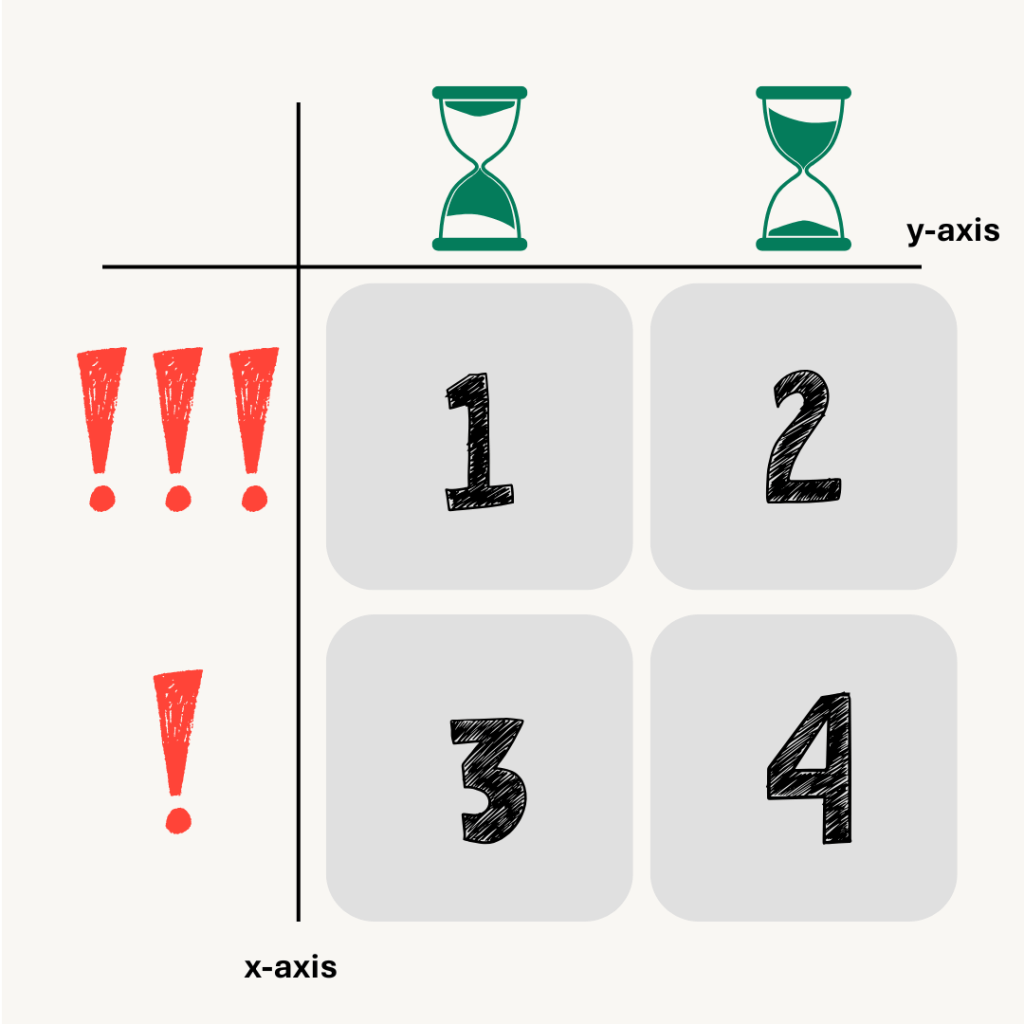
Box 1: Important tasks with immediate deadlines. These can be a frequent source of stress because they’re important and have upcoming deadlines.
Box 2: Important tasks with long-term deadlines. These tasks are good for planning and taking incremental steps towards goals.
Box 3: Urgent tasks with little importance. These are not really that important to you, but someone else wants it now.
Box 4: Unimportant tasks with long-term deadlines. These types of tasks produce little value and are often used as a break or distraction.
Those suffering with ADHD or focus challenges often struggle with planning and prioritizing. It’s common to be driven by urgent tasks that need to be done now, but fail to get started on those important tasks that don’t have as tight deadlines. And although each box serves a useful function, the goal is to expand the list of tasks in Box 2, because it allows us to plan ahead. Planning ahead reduces the stress of important and urgent tasks.
Encouraging your child to use this as a tool each week will help them improve their planning and focus.
Activity:
Work with your child on creating their own grid.
- Encourage them to jot down their activities and put them into the corresponding boxes.
- Consider what is a less important activity from boxes three or four and replace with the high importance activity instead. Ideally from box two or maybe from box one.
2. Make routines and time visual
Use picture schedules, timers, and visual checklists to help your child to see what’s coming next and understand how long tasks will take. A clear and clutter-free space along with consistent visual cues, like color-coded charts or images for different routines throughout the day – can reduce distractions, create structure and help children build focus and a sense of control.
Example:
Put a visual checklist next to your front door with things like backpack, lunchbox, and coat. This checklist is in a spot you and your child will pass on your way to school and keeping it visual makes it easy for your young child to understand and engage with.
3. Coach children through social situations
Research has suggested that children with ADHD and attention challenges may struggle with social awareness and how they are perceived by their peers.
- Practice taking turns and recognize social cues through role-playing.
- Talk through these situations and discuss what may have gone wrong, while also discussing what they could do differently in the future.
- Model positive social behaviors and even narrate your own thinking during these situations out loud
- Supervising your child while they are involved in activities with peers can provide opportunities for your child to build social confidence while allowing you to observe and guide along the way.
4. Validate their feelings, then give them tools
Children with ADHD often experience big emotions and may struggle with managing them. It’s important to first validate your child’s feelings. Let them know it’s okay to feel frustrated, overwhelmed, or excited. Then teach them tools like deep breathing, taking a movement break, using realistic self-talk, or using a calm-down space can help them learn to better manage big emotions over time.
As a parent, it can make all the difference when you’re able to stay calm and connected during tough moments. This allows you to serve as a model for managing emotions and encourage your child to reach out to you when things feel hard for them.
In Conclusion
ADHD Is Real—And Misunderstood. Check out our article on How to Spot the Signs ADHD. The reality is that ADHD looks different in every child – some may be more hyperactive, while others struggle more with focus.
If your child shows many of these signs across different settings (home, school, social situations) and it affects their daily life, it might be worth talking to a professional for support.



Newsletter
Be the first to know when new resources become available.
Follow Us :